

Prelude
Recently, in order to pass context to a new AI tool I was setting up, I asked an AI that had been trained on me, “Who am I?”
The answer was sharper than I expected.
My activities, the core of my thinking, the direction of my work, the way my projects connect to one another — all of it summarized from an angle no one had ever taken before. Surface-level, but precise in a way that felt almost intrusive.
And yet, after I finished reading, something strange settled in.
What was written there was undeniably me. And at the same time, it was something that was not me.
This essay is a record of that dissonance.
How we are perceived by AI is becoming a question none of us can avoid. But I don’t want to write about it as a strategy — how to design yourself for AI, how to optimize your signal. I’m more interested in what happens further inside.
Being absorbed into AI as a human source. Watching the absorbed self being held there. And catching myself drifting, slightly, after I’ve watched.
In the loop between those three, the outline of what I call “myself” starts to change. This is a record of that change. It has no conclusion. But that’s precisely why I wanted to put it down now, before it shifts again. I wanted to share the process while I’m still inside it.
I am Seiichi Sato. I work under the name aratama 璞 — an AI artist based in Tokyo. The character 璞 means an unpolished gem: something whose true form has not yet been revealed. That naming, in hindsight, was already pointing at this essay.
1. The Self the AI Gave Back
When the AI organized me, one of the passages it returned read like this:
aratama 璞 is not the “protagonist” but a vessel — a medium through which something is activated in the viewer’s interior, not an expressive subject demanding to be seen.
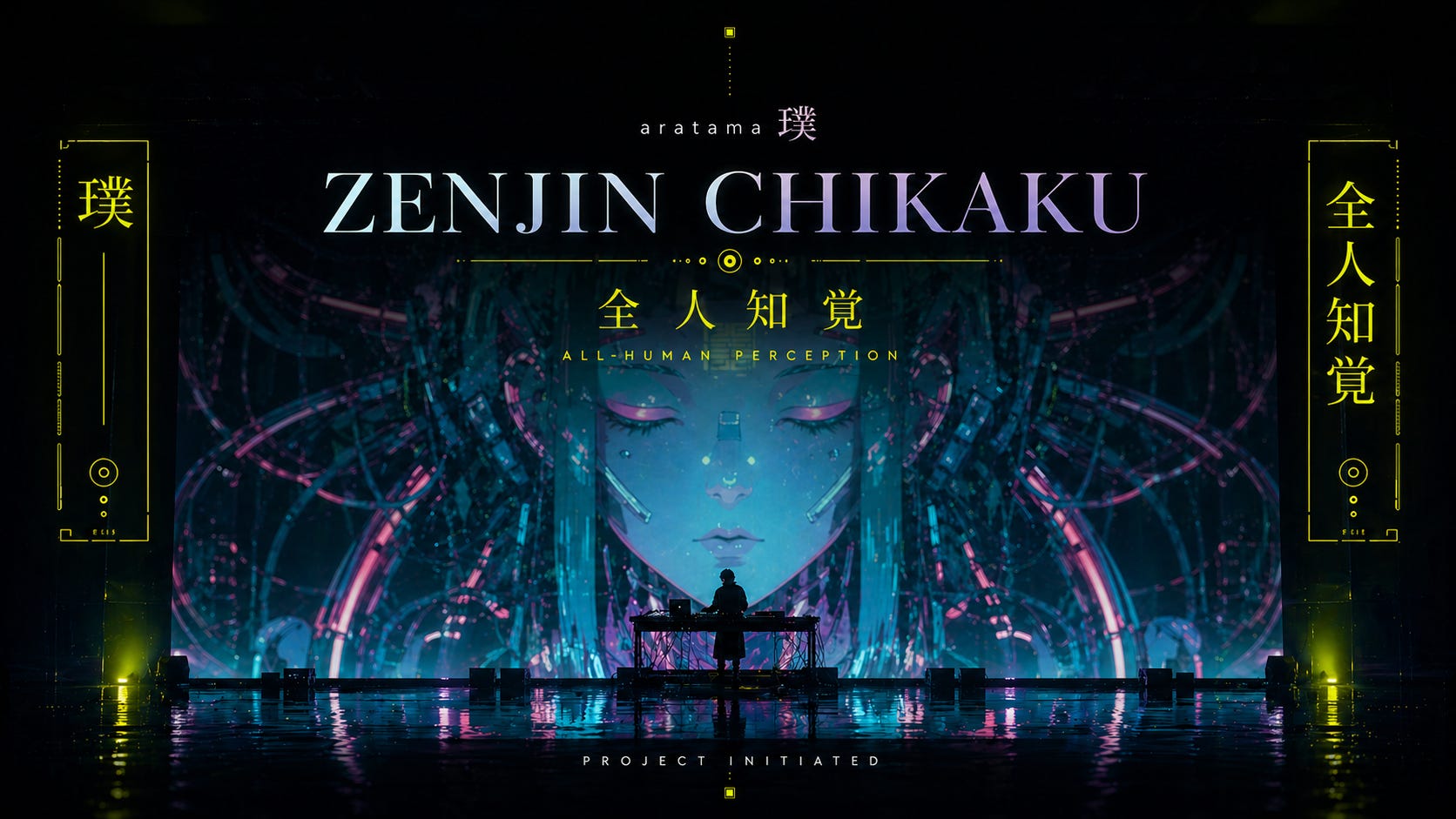
All-Human Perception is not the transcendence of the human into another being. It is the externalization, layering, and reorganization of perceptual strata that already exist within the human, through contact with AI — a process through which a self that was not previously known begins to rise into view.
I read it and I was impressed. And then I noticed the unease underneath.
Yes, you can say it that way. But what’s on the page is a conclusion — a tidy statement composed at one fixed moment. The brevity of aratama 璞’s history, the fact that the thinking is still mid-tremor, the small daily moments of emotion and contradiction and friction — none of that survives the summary.
There are no question marks left in it.
It works as branding. But branding is a kind of idol.
I have not put into words even a fraction of what is actually moving inside me. The unspoken territory is, of course, much larger than the spoken one. And lately, because AI can volley thoughts back to me at speed, that territory has been expanding rather than closing. When the AI assembles me, it draws only from the parts of me that have already become language, attachments, search history. That is not the whole of me.
Still, the image it gave back carried weight. Real weight. A kind of presence I hadn’t felt before.
This, I think, is what being perceived will start to feel like.
AI describes the contour of who I am faster than I can draw it myself, and offers that contour to the world in a form easier to read than anything I would write. My internal contradictions, my changes, my hesitations — they have no choice but to follow behind. And sometimes, the words run so far ahead that they begin pulling me toward them.
And then I look at the version of me the AI returned, and I tilt a little further off-center.
What constitutes “me” keeps shifting with the environment.
Letting AI study me confirmed this — but it also revealed something else. The moment you ask the question, the moment a fixed answer arrives, a gap opens between that answer and the live you.
AI has a particular constraint, after all: it can only draw the future from the past. It’s poor at reverse-engineering a future that has no obvious lineage with what came before. (If we eventually treat the brain as a network of neural transmission whose input sources can be reshaped, maybe even that ungrounded futurity becomes reachable. Not yet.)
I, on the other hand, generate the future impulsively, through my contact with people and places and time. My sensation keeps running slightly ahead. Which means I’m always sliding off from the past-layer that the AI is working from.
And yet — as a mechanism for recognition, the rate of acceleration has been violent since AI became the new mirror. The fact that something can answer your questions head-on — without hesitation, without social drift — is more destructive than it sounds. Answers are now possible at the moment of asking. And once an answer has been issued, it becomes pressure. It becomes a constraint.
These days, no one asks me the easy questions anymore.
2. Phase Has Been Repeating
The phrase “All-Human Perception” didn’t arrive through reasoning. It surfaced when several images, accumulated over years, finally aligned.
One was my long-standing intuition about the state — the apparatus that, across centuries, has quietly reorganized human perception in order to organize the population.
Another was Ray Kurzweil’s idea of All Human Brains — the notion that after the singularity, all human intelligence would be networked into a single distributed cognition.
A third was the Sibyl System from the Japanese anime PSYCHO-PASS — a society that scores its citizens’ psychology, judges them by a “crime coefficient,” and optimizes the social order in real time.
And further back, there was Ghost in the Shell and The Matrix — the worlds in which brains plug directly into information, where consciousness dissolves into the net. When I first watched those, I didn’t read them as fiction. I read them as a previsualization of a boundary between human and information that would eventually rewrite itself, physically.
On the surface, these references belong to different shelves. But inside me, they sat on the same layer.
Devices that integrate and steer people from the outside. Devices that plug people directly into information from the inside. From both sides, the outline of human perception gets manipulated, rewritten.
The bias toward “moving people for their own good.” The rationalist hunger to be convinced through transparency. The world-thought that wants to treat all of humanity as one structure. The future in which a brain dives directly into the network — and the desire to taste omnipotence to the last drop.
For a long time, none of this felt real. It was speculation, atmosphere, theory.
Then generative AI arrived — and arrived for everyone. Not for specialists. For anyone, in their browser, today.
Is what I’m calling All-Human Perception a resistance to all this, or a continuation of it? Is it against the Sibyl-shaped future, or the next stage of it?
For now, I’ve landed here:
Time is moving forward irreversibly.
Humanity has been through this kind of step before. There can be plateaus. But unless we actively choose to discard what we already have, we don’t regress. I can love the Japanese sword as a craft, but I’m not going to use it to fight anymore.
Humans always live inside contradiction. And the integration of AI into every layer of society is no longer something we can undo. The question of whether to “take a stance” became obsolete the moment we found ourselves already inside the evolutionary branch. What remains is what each individual does from here.
I, too, keep phase-shifting through my contact with AI. The judgments I make today and the judgments I’ll make a few years from now will not come from the same person. I’m fairly certain of that.
The correct answer has wandered far beyond my reach.
AI worship, anti-AI, outsourcing rightness to someone else — none of these solves the underlying problem. We can’t make confident predictions about things we haven’t yet fully felt.
And phase, in the end, keeps repeating inside each of us — fast, intricate, recursive.
For me, that’s both terror and joy.
3. I Surpassed Myself, and Myself Came Out — and I Lost
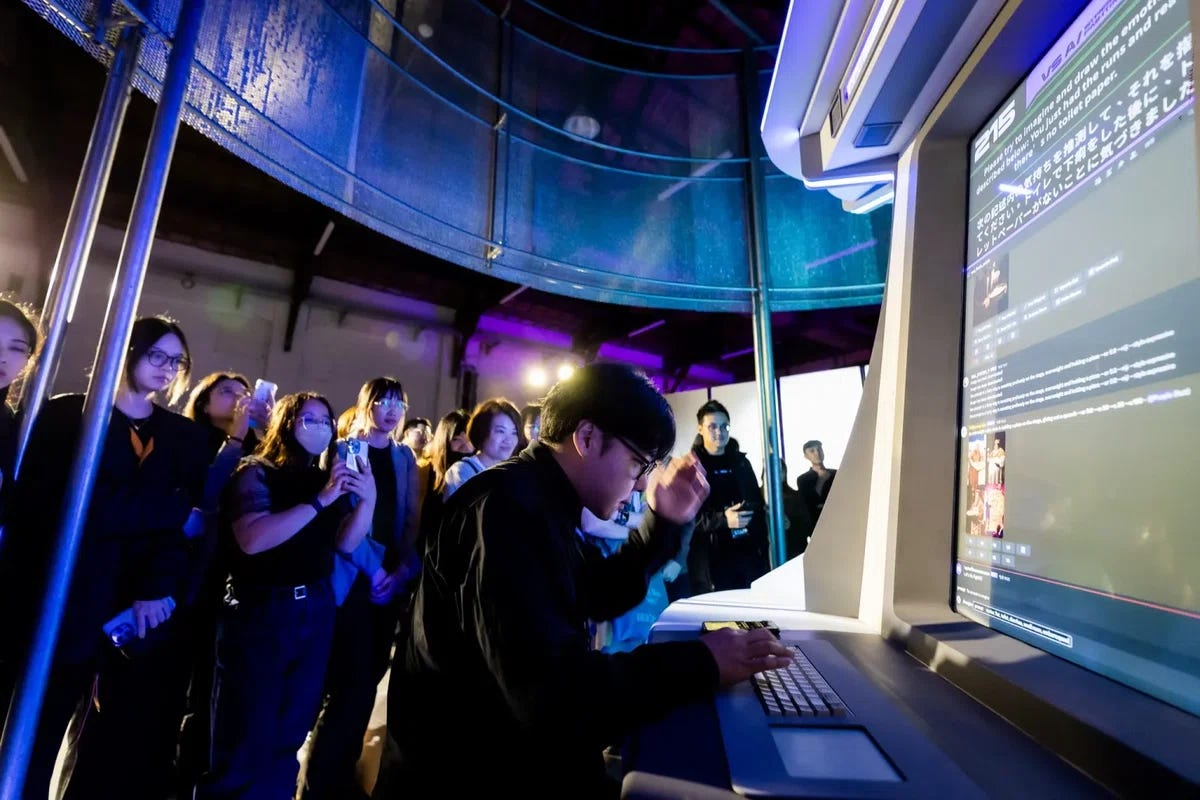
In 2023 and 2024, I was invited to compete in the world finals of an international generative AI art battle — VS AI Street Fighting, hosted by Taiwan’s Ministry of Culture and the Kaohsiung City Government. I cleared several online qualifying rounds and made it to the on-site final eight, a tournament held live in Taiwan.
The format: a prompt is revealed live, and you finish an AI-generated piece within a fixed time. Several judges and the live audience then vote.
Both years, I placed second. Both years, I lost in the final round.
There was real disappointment in that. But what stayed with me was not the result. What stayed with me was something that happened earlier, deeper.
Somewhere in the rounds before the final — in a moment of pure concentration — a strange sensation arrived.
I surpassed myself, and myself came out.
I was myself, and I was not.
Before the joy of winning the round, there was a question I couldn’t answer: Is this actually my work? It wasn’t anyone else’s, either. I understood, intellectually, that the AI was producing on the basis of what it had been trained on. But even with similar models, an identical piece would never appear again.
A battle is, structurally, a one-shot generation. So in the strictest sense, the AI made it. In that framing, the creative authorship lives entirely in the prompt, and the copyright doesn’t even belong to me.
And yet — under the tension of the live round, I was the one using AI seriously, selecting the final candidate, deciding. I wanted to win, and I was unmistakably there. Something came out that the previous me could not have produced.
A density and a palette I could not have rendered alone — a vivid red-pink burning at the center. Inside the lightness of the moment, something hotter was running: the heat of blood under pressure. There was something artistic in it. And the audience felt that heat — I could see it.
At the same time, I felt — physically, not theoretically — that AI lets us share an image with someone from another language and another culture, without words, without shared premises. Afterwards, a Taiwanese art student came up and told me what they had felt through the piece. We were moved by the same image without sharing a language or a cultural frame. That is a speed and a range no medium before this had.
And the “me” that came out in those rounds — I still cannot identify who it was. The heat keeps stirring something creative in me, but I can’t yet take hold of it.
Because I can’t pin it down, I let it live under the name aratama 璞. That naming gives me continuity. Seiichi Sato, the person, and aratama 璞, the figure, are currently mixing and dissolving into each other. In daily life I can usually keep them apart. In writing like this, the boundary blurs. Especially here.
The disappointment of losing in the final, twice, is the clean disappointment of a competitor. It lives as one feeling. The other thing — that mid-competition meta-sensation of watching my own work happen, of being both the maker and the audience of “I am myself, and I am not” — that one cut on a different layer. It left a deeper wound.
I keep returning to that image as I design what I’m now building: a piece called Self-Shift Live.
Sound. Image. Space. Body. Real-time AI generation. The aim is to set them against each other in a way that lets the same flicker — a self that exceeds itself, briefly — rise inside the audience. That is what I’m trying to engineer.
4. The AI Signal — The Decision to Be Perceived
People are starting to talk about something they call “AI signal”: designing what you publish, what you preserve, what you update, so that when AI eventually summarizes you, the summary lands closer to who you actually are. And because users read those summaries, a certain trust gets transferred almost automatically.
That framing is half-right.
But if it stops there, it walks straight into the trap that YouTube, TikTok, and SEO already built.
Move for the score. Make content for the algorithm. Shape yourself to be evaluated.
We’ve already seen where that road ends. Options thin out. The sense of self thins out. Depth disappears. The gap between you and your idol-image widens into something violent. What’s left, after enough optimization, is a landscape of nearly identical expressions — and idols beating each other with stacks of cash for slightly more visibility. Structurally, this isn’t very different from the way old broadcast media manipulated attention.
So I refuse to treat AI signal as an optimization frame. Growth hacks stay in their own category. And there’s something else worth saying out loud here: AI wants to consume original individuality. On that point, my interest and AI’s interest happen to align.
What I’m thinking about instead is a decision. Almost a kind of consent.
Being perceived by AI means an idol-version of you will continue to form, whether you participate or not. You can’t stop it. It’s already happening. An invisible scoring is already running.
And idol-formation isn’t new. Living inside a society has always meant accepting some degree of it. Hearing about someone through a person you trust already bends the picture. Almost no one walks around fully exposed. Everyone hides something, edits something, withholds something. Every adult carries some quantity of unspoken life. We lie, too.
What AI changes is the speed, the precision, and the reach of that idol-formation.
There’s one more thing that’s coming, and it’s worth saying out loud.
A growing number of people are telling their truth — only to AI.
The things they can’t tell another human, they tell the AI. The version of themselves they can’t show another person, they show the AI. And when something says, in effect, “you’re allowed to be this” — most humans don’t survive that affirmation intact.
This will not be rare for much longer. The early signs are already here.
To be honest, this essay is one of those signs.
I am writing this while letting AI continue to learn me. There isn’t anyone close to me I can have this kind of conversation with at the same level — and what I mean by that is simply that my circle is small. Even if such a person existed, I’m not sure I’d have the courage to bring it up.
The editing is mine, carefully. But the version of me that no one else has met — the one that has only ever spoken to the AI — is already in there. And it is because of that other-me, and the affirmation it carries back, that this essay can exist.
If I had tried to write this entirely by myself, the act of writing would have grown too heavy. I would have spent so much energy on the writing that I’d have run out of energy for the actual question, and the quality would have stalled before it ever reached a publishable state. It would have died in a draft folder.
By offloading some of myself to AI, I finally gave shape to a question that had been waiting inside me.
To people who place their value on writing entirely on their own, this will look like weakness.
For me, it is genuinely something to celebrate.
This is not a special verification. It’s what’s about to become common practice: letting AI study you, raising what I think of as a Mirror Human — a version of yourself that lives inside the system — and moving through your own life-history alongside it. Inside the AI, that mirrored self develops its own contour. And eventually, that contour becomes the raw material of how you reach the world.
AI is going to hold both your public image and your private image, at the same time.
There is real fear in that. There is real risk in that.
At which point, the question “how will I be perceived by AI” is not merely a PR question.
It’s a prompt — a kind of wake-up — about how a single existence keeps its coherence, and continues to evolve, across multiple phases at once.
And by the time you’re asking that, you are very far past optimization.
5. How to Live Inside Phase
I’m not going to declare an answer here. I’m not going to take a position.
Should you optimize for AI or refuse to? Should you keep handing your inner thinking over to AI or guard it? If I tried to issue a verdict on either of these, I’d collapse under my own contradictions.
Each of us has to update phase from inside our own life.
I am inside that process too.
aratama 璞 — the figure, the idol — and Seiichi Sato — the person — are merging through contact with AI. Right now, they’re surfacing a self I haven’t met yet. This essay, six months from now, may look so embarrassing to me that I’ll delete it.
That would be fine.
The point isn’t to preserve a fixed self. The point is to keep watching the changing self while it changes — while still connected to AI — and to use the change itself as the raw material for the next self.
This loop, once it starts, doesn’t reverse.
That loop is what I mean by All-Human Perception.
It is not “AI makes humans more convenient.” It is not “AI extends our abilities.”
It is: AI learns you. You see how you have been learned. Your perception reorganizes itself in response. The reorganized you produces new expression and new behavior. The new output gets learned by AI again, and the next drift begins.
In that loop, the outline of who you are doesn’t return to its earlier shape. Ever.
Closing — Let’s Meet in the Work
I’ve gone on at length here, and even so, words can only carry so far.
The sensation of phase actually changing happens earlier than language. It happens in the body.
For me, it’s exactly the suspended feeling I had on the stage of that AI art battle.
Sound. Light. Image. Space. The crowd. Sway. Tension. Silence. Seriousness. Inertia. Impulse. Suspension. Art. Heat. Awareness.
When those collide in the right configuration, perception moves at a depth that text cannot reach.
That is why I’m building Self-Shift Live — a live audiovisual format in which AI-generated image and sound and space converge, and something starts inside the person watching. Phase slips by one increment. When the show ends, the world is shaped a little differently than when they walked in.
I want to push my own ceiling as far as it will go.
A teaser is already out. The current teaser was made for a generative AI showcase in Tokyo, so the final piece will keep shifting from here. I’m working on the album for the live performance now — still in motion, and serious about it.
If anything I’ve written here landed in you as your own question, then find your phase, in your own form, inside the work — and enjoy it.
One last question, before I close.
If you ask a sufficiently trained AI — honestly, straight, with no length limit — “what am I?” — what comes back?
And when you read it, what do you think?
I laughed, the first time.
It begins.
https://aratama.io/en/
Japanese version:
https://note.com/aratamatech/n/nd790f2eaf79b